
Marisa and I both joined Mútua recently — she as CPO, I as Head of Growth — and most of our first months here have been spent doing what new hires in a new ecosystem are supposed to do: learning. Learning from investors, organizations and partners who have been working in the impact space for years, asking the same question from different angles and trying to figure out how to challenge the status quo
We are still on that learning curve but on different fronts. Marisa is the one carrying the product roadmap, and the friction she kept hearing was not about lack of capital or lack of interest, but a critical lack of visibility. Investors struggle to locate innovators who align with their specific strategies, while high-impact innovators remain in the dark about what investors actually prioritize. Consequently, both sides operate in a vacuum, without a clear sense of who is truly paying attention.
I asked Marisa to walk me through a new profile scoring system we are rolling out to address this gap. It builds on our architecture whereby every organization on Mútua is already indexed against the Sustainable Development Goals (SDG). While investors can already use the platform to vet a pipeline against the causes they care about and innovators can search for investors supporting the same SDGs, this new score system enriches the intelligence layer on top to better quantify alignment.
Start at the top. What is the scoring system actually doing?
The score is a dynamic measure of how complete an organization's profile is, broken down across nine sections (Overview, Offering, Impact, Traction, Market, People, Achievements, Financials, and Materials). Each section is weighted to reflect how much that information matters to an investor making a first assessment. Fill out the People section completely and 15% of the score is yours. Leave Financials empty and you lose 20%. We have also built a banner inside the product that explains, in plain terms, what a given score means and how to improve it. The score is not a verdict on the organization. It is a signal to users about what to fill in next, and a signal to investors about which profiles carry enough self-reported information to be acted on. In return, users will increase their profile visibility on the platform, directly influencing ranking in search results and inform investors about which profiles have enough self-reported information to act upon.
Financial information then carries the heaviest single weight in the score, at 20%. Why that decision?
When an investor looks at an organization, one of the first things they want to know is where it sits in its funding journey: still in ideation, post-revenue, somewhere in between. That tells them whether a conversation makes sense for the kind of capital they deploy. Financials is not the only section that matters, thematic alignment matters just as much for whether a partnership is the right fit, but this section serves to help investors find what matches their investment style and organizations to find others in the same stage.
Can you walk us through the scoring tiers and help us understand what it takes for an organization to improve where it stands, what is the single most useful thing they can do?
Verify and claim the profile. Mútua already tracks close to 50,000 organizations across the social impact ecosystem, each of them already has a profile on the platform, populated from public data we have collected and structured. The logic is the same as on any other networked platform: an unverified profile is hard for the system to weigh with confidence, and easy for a user to scroll past. After that, the second highest-leverage action is enriching the information that is already in your profile to ramp up your score.
Last one. The scoring system isn't trying to be the whole answer to visibility, just the first move. What does it open up, once it is in place?
We've built this scoring layer to act as the platform's connective tissue, converting static Sustainable Development Goals and Theories of Change tags into a dynamic measure of systemic alignment. The scoring system gives organizations a clear roadmap to stand out in a crowded landscape by proving their systemic value and alignment, while giving investors the capability to instantly audit their alignment with specific market and investment needs.
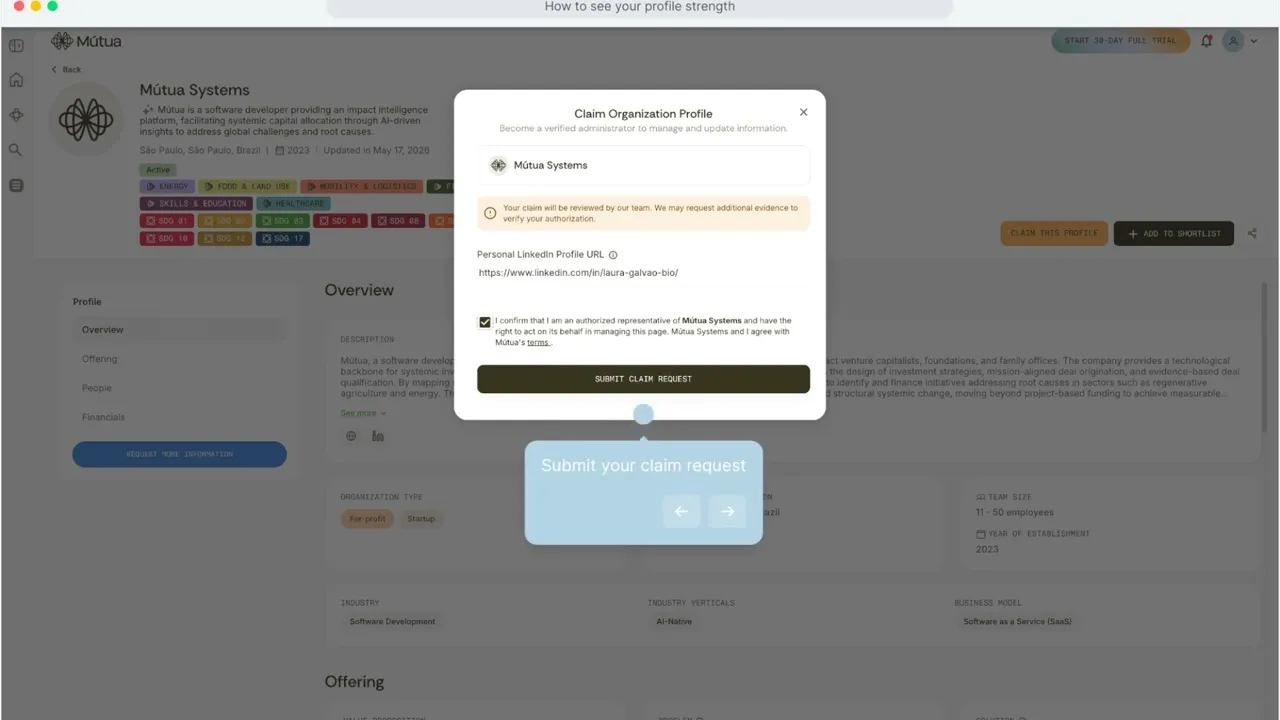
Check out the overview for the new feature on the video above. It is the first of several visibility features shipping this quarter; the rest follow over the coming weeks. Organizations and investors with an existing profile on Mútua are encouraged to log in, verify, and bring their profile up to date.