
Read the transcript of the video below.
Débora Omena:
Impact capital has never been larger. The GIIN estimates that more than $1.5 trillion now sits in impact investments, and with that growth comes more scrutiny. Funders, boards, and the next generation of wealth holders want to see the reasoning behind investments. Why this problem? Why these solutions? Why this fund? In practice, most impact investors work from a thematic scope, a few themes, some target outcomes, and a screening criteria. So today, I am once again joined with Marisa, our CPO at Mútua, and we're gonna talk about what happens once an impact strategy is written, and how it can become the starting point for finding and backing the organizations that move it forward. Marisa, welcome.
Marisa Teh:
Hi. Thank you for having me.
Débora Omena:
Marisa, before we start talking about how strategies are built and all the cool things that we've been developing for these past months, why does an impact investor needs one at all? What changes when the reasoning is written down?
Marisa Teh:
An impact strategy mandate is effectively a coherent set of choices that informs where investor focuses their capital and efforts given very limited resources and high uncertainty. The strategy basically serves as a shared language on the vision, the solutions that they want to go after, the types of challenges that they want to address, the outcomes that they wanna drive, that vision that aligns stakeholders around a common set of outcomes.
Débora Omena:
Now, we know that's very important, but we also know that it's not a one-size-fits-all thing, right? We work with family offices, fund managers, and catalytic investors. Does the strategy do the same job for each one of them? How do they differ?
Marisa Teh:
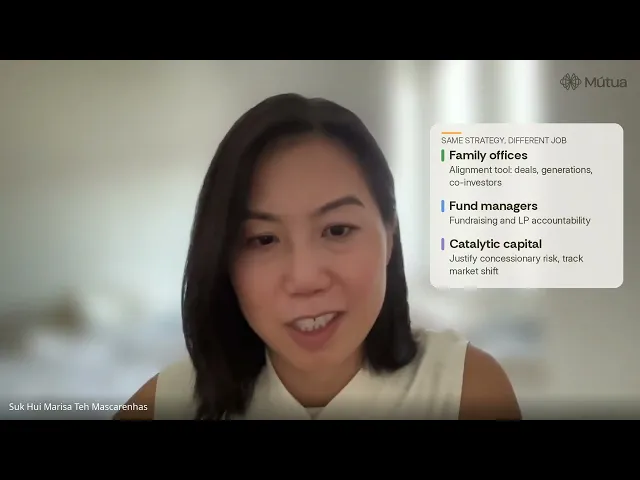
While all three may use impact strategy to anchor their decisions, their primary operational focus shifts from one another. Their core operational work is slightly different. For family offices, as an example, the strategy is used as an alignment tool. Externally, it's used to find deals and to be able to evaluate deals and fund commitments on a consistent basis. Internally, it's used to align family members across generations around a unified vision. We are also seeing that more and more family offices are using the strategy to mobilize peer capital, such as syndicating deals or bring co-investors onto a shared thesis.
Whereas the fund managers, the strategy is heavily used more for fundraising, it's for LP accountability. It's used to help them to raise capital backed by systemic evidence and experts. And throughout the fund's life cycle, it serves as the baseline against which they can report real impact performance, ensuring that the initial impact narrative matches the real world execution.
Lastly, catalytic investors. They're made up of foundations, DFIs, who take concessionary risks and offer flexible terms. So the strategy needs to be able to help them justify to their stakeholders why they're taking on higher risks, why might they offer lower returns to their boards and partners, and they must be able to track catalytic metrics. For example, does the market start to begin funding similar models independently after their participation?
So in short, to your question, all might use the strategy to anchor their decisions, but the focus shifts slightly from funding deals to fundraising to mobilizing others. However, as no one has built strategy in the same way, it really makes it difficult for people to be able to compare their strategies, and this slows down the very mobilizing everyone depends on. So this is where Mútua is stepping in.
Product demo: the strategy page in Mútua
Débora Omena:
That's awesome. Now let's make it concrete. I'm excited to share how that is looking inside a product. Let's say a fund manager has just defined its strategy. What do they see in Mútua and what can they do with it from day one?
Marisa Teh:
Perfect. So the living strategy is typically hosted in a strategy section. So this is a new area, a new hosting area where users will be able to find all the active mandates that are available. Let me just take you through one. So this is a sample one created on food systems in Latin America. You can see up front very quickly that this particular investor is currently deploying capital and fundraising, specifically in Brazil, looking to cover these types of systems and systemic goals.
The strategy page is made up of two sections. In one side, it's on the mandates, where the user would be able to find out more information about the size of the tickets, the type of capital that they're looking to deploy, or how long of a period are they looking to deploy for, and the types of organizations that they're interested to target. This makes it a lot easier for startups to be able to know what they're looking for before they reach out to these types of investors. Same sort of areas given to fundraising, where the user or viewers would be able to find out more information about what they're looking for.
Onto the impact thesis. This is where there are three sections that makes up an impact. So it starts with problems, where the, you know, onlookers will be able to see what's the synthesized problem or challenge that the strategy is intended to address, and find out much more about the breakdown of all the different challenges and click on the individual pages to find out more. They can also see the choices of solutions that the investor might be interested in. So again, they'll be able to scroll down and see the different links. For a startup, they'll be able to see whether do they fall under any of these kind of remits before they reach out as well. And lastly, the types of goals that the investor's looking to achieve by deploying capital in this area.
You can also see up front that this investor has, a mandate has been backed by two experts, and you'll be able to click onto LinkedIn to find out more about the experts who have contributed. This is one of the key values of strategies being created by Mútua and hosted on Mútua. And should you be wanting to find out more information, there are links to more white papers here that are relevant to this specific thesis.
Débora Omena:
We always talk about how a Strategy Studio is able to take a stale strategy and make it a living strategy. What does that mean in practice?
Marisa Teh:
This is really where I see the magic happening, right? Because we believe from day one, when we envisioned working on a strategy page, that a strategy is not a static document. It's by no means just a PDF sitting somewhere in a folder. We envisioned it to be a living, dynamic workflow from day one, so much so the investor can be able to use it to kick off actionable, strategy-driven operations. They'll be able to activate sourcing, screening without having to type in their metrics again. Neither do they need to step out and go to a different platform to do that. We're imagining that they'll be able to do all that within Mútua and also see the underlying evidence and theory chains mapping directly to those solutions that are relevant to the strategy.
Secondly, as you saw before on the strategy page, you can see where the investor is currently funding, their investing, what sort of stage are they at. So this acts as a ability for them to signal their intent across the platform. Whether a fund manager is fundraising or a family office is indicating they're actively investing here, it's able to send those signals across the ecosystem, and that opens up for targeted inbound from different stakeholders, such as co-investors, strategic partners, to share their level of engagement with their thesis. And because all these updates are done on a real-time basis as the market shifts and the portfolios grow, we believe that we're able to turn the strategy from being a static intent into an active collaborative network effect.
Roadmap
Débora Omena:
After all this, which is a lot, I am very curious, Marisa, because when I look at your roadmap, it really does look like this is a simple step into something that is about to become even greater, even bigger. So I am curious to know, what is the vision for this feature?
Marisa Teh:
So I'll give you a little bit of a sneak peek into what we're currently working on. We're deepening our entire origination stack so that investors can move seamlessly from initial sourcing to screening, more faster. Right now, users might be able to share their workspace. As you saw before, they are able to see what the active mandates are. What we're building next is designed to give investors more clarity, more confidence when evaluating options. So instead of seeing just a list of organizations and companies, teams will be equipped to prioritize recommended solutions based on deep impact logic. They would also be equipped to analyze the underlying systemic risks and understand the causality behind each intervention. And basically, by doing that, they're able to see how specific solutions drive intended outcomes before committing capital.
Débora Omena:
That's amazing. What stays with me in all that is how much shorter the path becomes when the strategy and the search for organizations live in the same place, right? The reasoning, it stays intact, and the organizations working towards the same change are visible from the start. Thank you so much, Marisa, for that walkthrough and everything else. And if you would like to see a strategy page in action, you just have to log into Mútua. If you're interested in having your own strategy there, you just have to click in the link in the comments and book a talk with our team. We're gonna be excited to have you around with us. Thank you so much.
Marisa Teh:
Thank you.